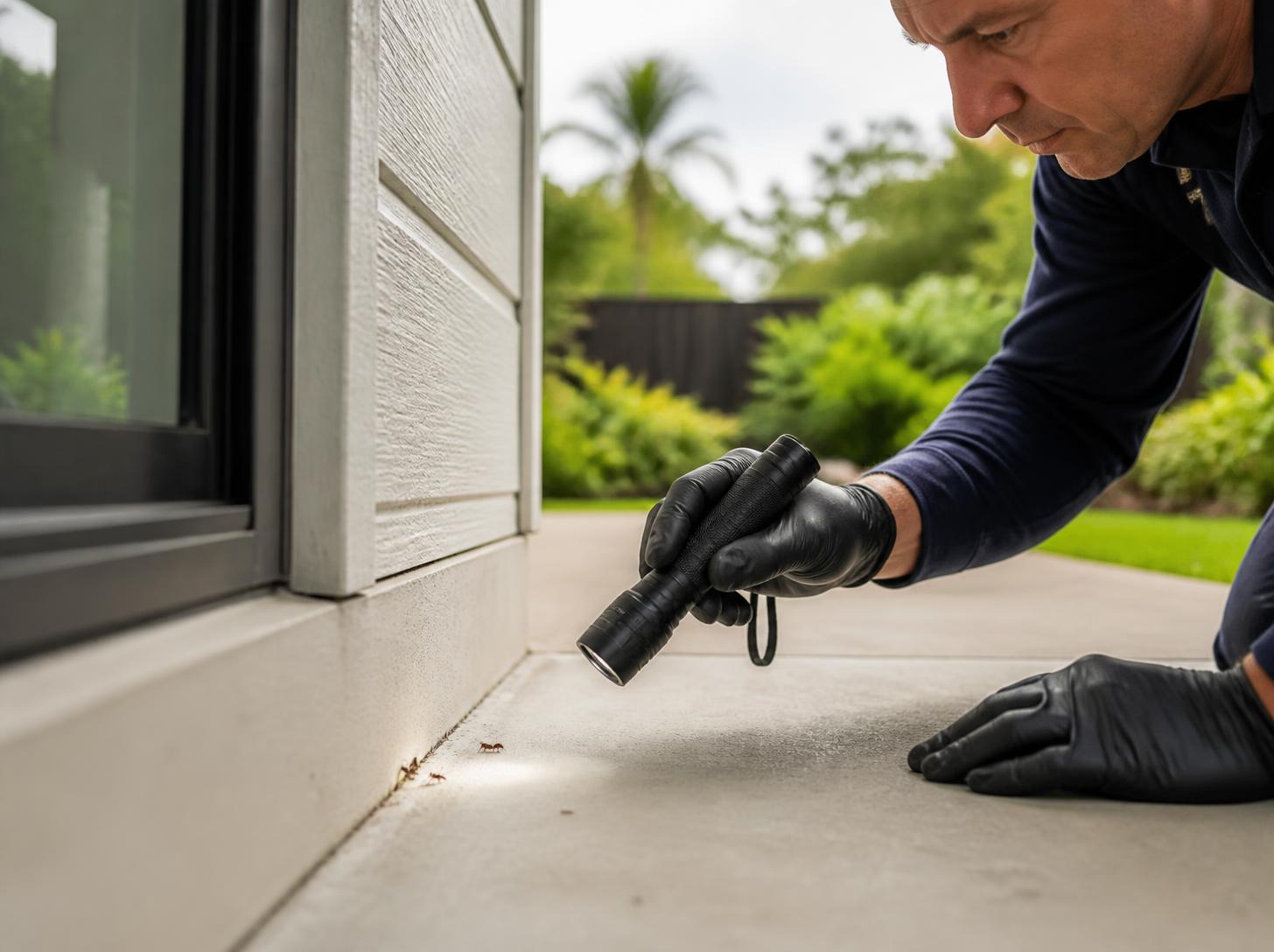
You spray the trail. The ants die. Three days later the trail is back, slightly to the left of where it was. So you spray again.
If that sounds familiar, you almost certainly have Argentine ants (Linepithema humile) — and the spraying is not just failing, it is actively making the problem worse. Effective Argentine ant treatment works the other way round, and this guide explains why.
Why Argentine ants break the usual rules
Most ant species you might have dealt with elsewhere behave in a predictable way: one nest, one queen, a defined territory, and hostility toward neighbouring colonies of the same species. Kill the queen and the colony dies.
Argentine ants do none of that.
- Many queens. A single Argentine ant colony can contain dozens or hundreds of reproducing queens. Killing some achieves very little.
- No territorial boundaries. Separate nests do not fight one another. They cooperate, exchanging workers and resources freely, forming what researchers call super-colonies that can extend across entire neighbourhoods.
- They relocate readily. Nests are shallow and mobile. An Argentine ant colony can pick up and move in a matter of hours if conditions turn against it.
- They farm honeydew. Worker ants collect honeydew, the sugary liquid produced by aphids and scale insects, and protect those insects from predators in return. A garden full of aphid-covered plants is a reliable sugar supply that keeps a super-colony going.
That last point is the crux of the problem.
What spraying actually does: budding
This is the single most important thing to understand. When you apply a repellent surface spray to an Argentine ant trail, the colony detects the chemical barrier as a threat. Its response is to split — queens and brood disperse in several directions and establish new satellite nests away from the treated zone. This is called budding. You killed the workers you could see, and turned one nest into three or four.
This is why the trail reappears "slightly to the left". It is not the same trail. It is a new nest.
Repeat the process monthly for a summer and you can convert a manageable single-nest problem into a distributed one spread across the whole section. We see the results of this regularly — properties where the owner has been diligently spraying for two years and the situation has steadily deteriorated.
How to identify them
- Size: Small — 2 to 3 mm
- Colour: Uniform light to mid brown, no distinct markings
- Trails: Dense, continuous, purposeful. Argentine ant trails look like traffic, not like scattered individuals wandering about.
- Disturbance response: They keep going. Most ants scatter frantically when a trail is disturbed and take time to regroup; Argentine ants largely carry on.
- No smell when crushed. Distinguishes them from Darwin's ant (Doleromyrma darwiniana), which produces a sharp unpleasant odour.
- The practical test: trails that return within days of a supermarket spray.
The main Auckland lookalike is the white-footed house ant (Technomyrmex jocosus) — similar size but darker, with distinctly pale, almost white feet and lower legs. Usefully, it responds to the same treatment approach, so getting this particular distinction wrong is not costly.
The Department of Conservation maintains identification guidance, and treats Argentine ants as a significant environmental pest. DOC notes that they kill and displace native invertebrates, and will eat lizards, bird eggs and newly hatched chicks.
Where Argentine ants are in New Zealand
Argentine ants were first found established in New Zealand in January 1990, at Mt Smart Stadium in Penrose, Auckland. Manaaki Whenua Landcare Research now records them in Northland, the Coromandel Peninsula, Bay of Plenty, Waikato, Hawke's Bay, Wellington City, Nelson City and Christchurch, as well as across Auckland. The Department of Conservation notes that nests travel in anything moved from the ground: potted plants carry the highest risk, followed by garden soil and bark, bagged building materials and camping gear.
Within Auckland they are widespread, and Auckland Council lists them in its Regional Pest Management Plan for sustained control across the whole region. If you are moving plants or soil from an infested property, check them first.
Where they nest in Auckland properties
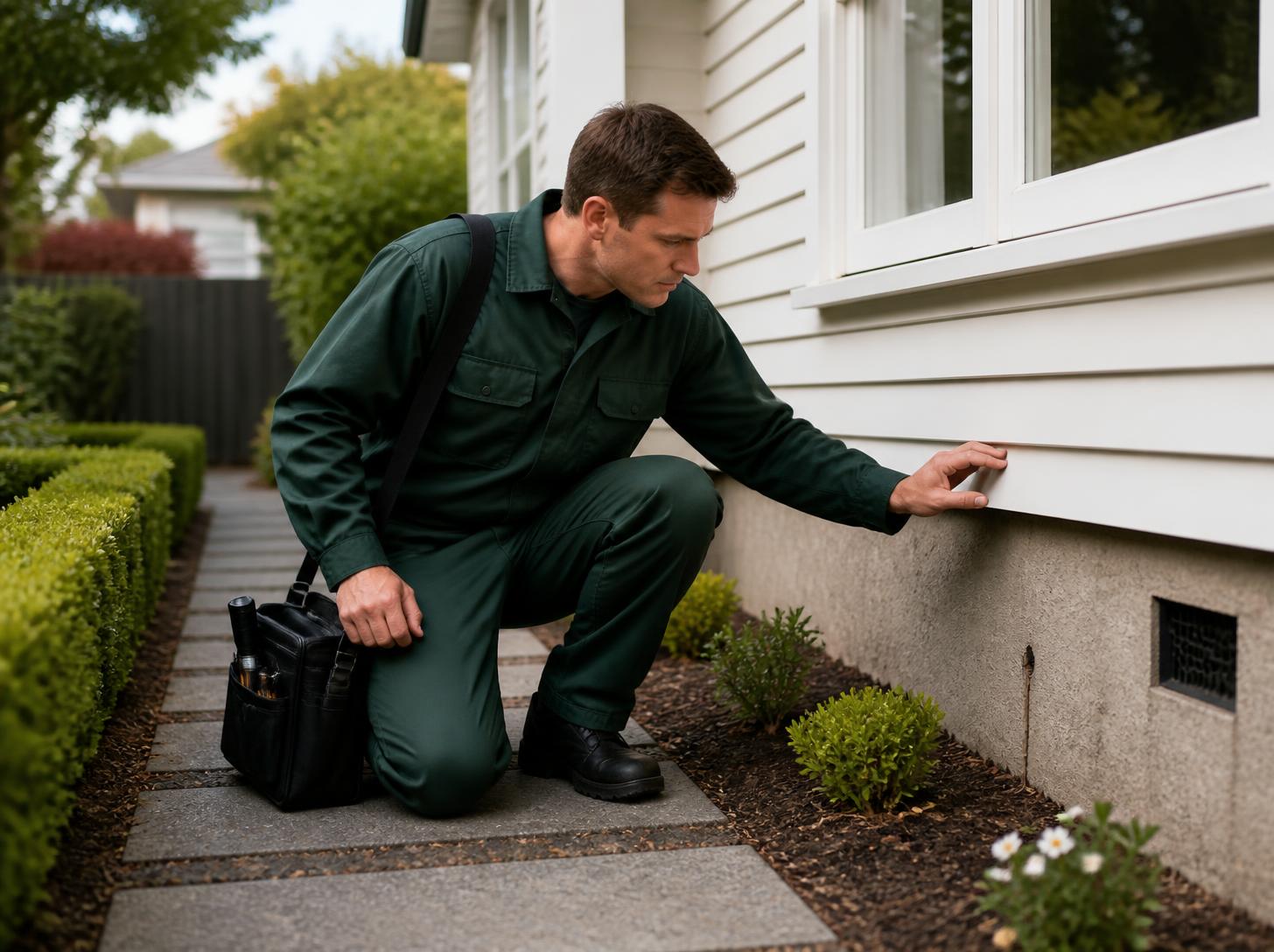
Argentine ant nests are shallow and opportunistic — they are not deep excavated structures. Common locations:
- Under paving, concrete paths and patio slabs, particularly at the joints
- Along slab edges and beneath the bottom plate of the wall framing
- In retaining walls, especially timber ones, and behind landscape edging
- Under pot plants, in garden bags and in stacked materials
- In wall cavities, roof spaces and subfloors — they will nest indoors given the chance
- In the mulch and leaf litter against foundations
They come indoors for two opposite reasons: during dry spells seeking moisture, and after heavy rain when their shallow outdoor nests flood. This confuses people, because both a hot dry January and a wet March can push them inside.
Why new houses get them so badly
If you have moved into a new build in Flat Bush, Westgate, Albany or Hingaia and are overrun with ants, this is why: earthworks fragmented an established colony.
Land being developed usually had a well-settled ant population. Bulldozers break the nest structure apart, and the fragments — each with its own queens, because Argentine ants have plenty — relocate into the nearest available shelter. Which is your new house, with its warm slab edge, its weep holes and its freshly landscaped garden.
It is not a build defect, it is not a hygiene problem, and it responds well to correct treatment. It is also close to a rite of passage in Auckland's newer subdivisions.
The best way to get rid of Argentine ants: non-repellent baiting
The best way to get rid of Argentine ants is a slow-acting, non-repellent bait, usually a gel bait, placed on their active trails. Worker ants carry it back and feed it to the queens and brood, which is the only way to reach a colony with hundreds of queens. It works best alongside cutting off honeydew from aphids and scale, and with no surface spraying at all. It does the opposite of spraying, because the ants cannot detect the bait as a threat.
Confirm the species
Argentine and white-footed house ants need baiting. Some native species need nothing at all.
Work out what they're currently feeding on
Ant colonies switch between sweet and protein according to what the brood needs, and this changes seasonally. Bait matched to the wrong preference gets ignored. Where they are tending aphids or scale for honeydew, those plants get treated too, so the gel bait becomes the best sugar source on offer.
Place bait on active trails
Not where you want ants to be — where they already are. Foragers carry it back and distribute it through the colony by trophallaxis, reaching the queens and brood.
Treat the perimeter with non-repellent product
Chosen specifically so it does not push foragers away from the bait.
Review at 2 to 3 weeks
Re-bait any nests still active. Large super-colony infestations sometimes need a second round.
The slowness is deliberate and it is the point. A bait that killed on contact would kill the forager on the path and never reach the queens. The ants need to survive long enough to get home and share it.
Please stop using your own spray during treatment. This is the most common reason a professional ant treatment underperforms. Household repellent sprays push ants away from the bait they need to be carrying home, and can trigger the budding you are trying to avoid. If you want to clean a surface, plain soapy water removes the pheromone trail without repelling anything.
What you can usefully do yourself
- Wipe trails with soapy water — removes the pheromone trail without repelling
- Move mulch, pot plants and stacked materials away from the foundation line
- Fix leaks and drips; ants come indoors for moisture as much as food
- Store sugar, honey and pet food in sealed containers
- Trim vegetation touching the building — branches are bridges past any perimeter treatment
- Seal gaps around pipe penetrations and along slab edges where you can
The neighbourhood problem
Because Argentine ant super-colonies extend across property boundaries, your result is partly determined by what your neighbours do. A well-treated property adjacent to an untreated one with a large nest will see pressure return.
This is not a reason to skip treatment — a maintained property stays substantially clearer than an untreated one. But it is a reason to be realistic about outcomes, and where several neighbouring properties are affected, treating them together produces a much better result than any one of them acting alone. If your street has a shared problem, it is worth a conversation over the fence.
Typical cost for ant treatment in Auckland is $150 to $290 including GST, with large super-colony infestations across a section running $250 to $450.
Frequently asked questions
Why do ants come back after I spray them?
Because supermarket surface sprays are repellent. With Argentine ants a repellent spray triggers budding — the colony detects the treated area, splits, and establishes new satellite nests elsewhere. You kill the visible workers and multiply the number of nests. Non-repellent bait does the opposite: ants walk through it undisturbed, carry it home and share it with the queens.
How do I know if I have Argentine ants?
Three signs: they are small (2–3 mm) and uniformly light brown; they move in dense, continuous trails rather than scattered individuals; and when you disturb the trail they do not scatter and regroup the way most ants do. The strongest practical indicator is that trails reappear within days of a supermarket spray.
How long does ant treatment take to work?
Expect a marked reduction within 5 to 10 days and full control in 2 to 4 weeks. Baits are deliberately slow-acting — if ants died on contact they would never make it back to the nest, and the queens, which are the actual target, would survive.
Why does my brand-new house have ants?
Construction disturbed an established colony. Earthworks fragment nests and displace ants into the nearest shelter, which is your new house. It is very common in Flat Bush, Westgate, Albany and Hingaia. It is not a build defect and it responds well to proper baiting.
Are Argentine ants dangerous?
Not to people directly — they do not sting and are not a significant disease risk in homes. They are a contamination and nuisance problem indoors, a real issue for food businesses, and a recognised environmental pest that displaces native invertebrates, which is why the Department of Conservation tracks their spread.
Are Argentine ants an invasive pest?
Yes. Argentine ants are an invasive pest species in New Zealand, first found established in Auckland in 1990 and now spread well beyond it. In the Auckland region they are listed in the Regional Pest Management Plan for sustained control, and it is an offence to breed, distribute, release or sell them. They are not classed as an unwanted organism nationally, so there is no government eradication programme for household infestations.
Why should you not squish ants?
Squishing a few foragers achieves nothing: they are a tiny share of the colony and are replaced within hours, while the queens keep laying safely in the nest. Crushed ants also leave the scent trail intact. With Argentine ants you actually want foragers alive, carrying ant bait home. Wipe the trail with soapy water instead, which removes the pheromone without triggering the colony to split.
- Department of Conservation — Argentine ants
- Manaaki Whenua Landcare Research — identification
- Ministry for Primary Industries — biosecurity
- EPA New Zealand — insecticides and pesticides at home
- Manaaki Whenua Landcare Research — Argentine ants in New Zealand
- Manaaki Whenua Landcare Research — Linepithema humile (distribution and biology)
- Auckland Council — Argentine ant (Regional Pest Management Plan)
- UC IPM — ant budding and insecticide sprays