Borer · Auckland-wide
Borer Treatment Auckland
Borer treatment for Auckland homes: subfloors, roof voids, weatherboards and furniture. We confirm whether borer is active before treating. Written quote.
- Species identified before anything is treated
- Typical cost $350 – $950 incl. GST — quoted up front
- Written record of products used and where they went
Borer treatment in Auckland: the short answer
Borer treatment in Auckland typically costs $350 to $950 including GST: a roof void from about $350, a subfloor from about $750, and a whole house or furniture quoted after inspection. The usual culprit is the common house borer (Anobium punctatum), a small beetle whose larvae tunnel through the sapwood of untreated timber for three to four years before chewing their way out through round flight holes 1–2 mm across. Old flight holes are not proof of an active infestation. Plenty of Auckland villas carry damage that stopped decades ago. We confirm activity first, from fresh holes and fresh bore dust, and treat only what is active. Here is how to tell if borer is active.
Signs to look for
Signs of active borer in your house
- Fresh flight holes with pale, clean edges. Old holes are dark and dirty, and are often clogged with paint or dust
- Small piles of fine bore dust (frass) below timber: on floors, windowsills, stair treads or in the roof space
- Small brown beetles on windowsills or caught in cobwebs during the flight season, roughly October to February
- Crumbly or powdery edges on floorboards, skirting, stairs or furniture when pressed with a screwdriver
- Soft or springy floors over a damp subfloor, where borer and moisture tend to go together
- A builder's or pre-purchase report noting "borer present". Ask whether it is active or historic
If any of these sound familiar, describe what you have noticed when you call — where it is, when it started and what you have seen. You do not need to identify anything yourself. Call 09 925 0448 or request an estimate online.
Get a free estimate
Tell us what is going on. We will come back with a firm price, usually the same day.
No call-out fee · No obligation
Know what you have
Borer in Auckland homes: common house borer, two-toothed longhorn and powderpost beetle
Three beetles cause almost all the borer damage in Auckland homes, and they differ in which timber they eat, how much harm they do and how they are treated. The huhu is not one of them: it is a large native beetle whose grubs live in damp, rotting logs and stumps rather than the dry timber of a sound house. Our guide to huhu beetles and grubs explains the difference.
Common house borer
Anobium punctatum: also called the furniture beetle or woodworm
A small brown beetle, about 2.5–5 mm long, and the cause of most insect damage to building timber in New Zealand. Its flight holes are round and only 1–2 mm across, and its bore dust feels gritty between the fingers. The larvae feed mainly in the sapwood of untreated timber, including radiata pine, rimu and kahikatea, grow faster where the air is damp, and pupate inside the wood. Adults emerge from about October to February, most of them between November and January.
Two-toothed longhorn
Ambeodontus tristis: native
A native longhorn beetle up to 25 mm long that leaves oval exit holes roughly 3–7 mm across. Its larvae can stay in the wood for anywhere from 2 to 11 years and, unlike house borer, tunnel through heartwood as well as sapwood. Untreated rimu in a damp, poorly ventilated subfloor is the classic target: bearers, joists and floor framing can be hollowed to a thin shell before anything shows on the surface. Adults emerge in autumn and early winter.
Powderpost beetle
Lyctus species
It feeds in the sapwood of seasoned hardwoods, not the softwood framing most houses are built from, so in New Zealand it turns up mainly in furniture, joinery and hardwood flooring such as tawa, oak and ash. The frass gives it away: very fine and soft, like talcum powder, where house borer dust is gritty. Exit holes are round and under 2 mm. Adults usually emerge in spring, around October and November, and one generation typically takes about a year.
Our method
How we treat borer
Every job follows the same sequence, because skipping a step is how treatments end up being repeated at your expense.
Inspection: active or historic?
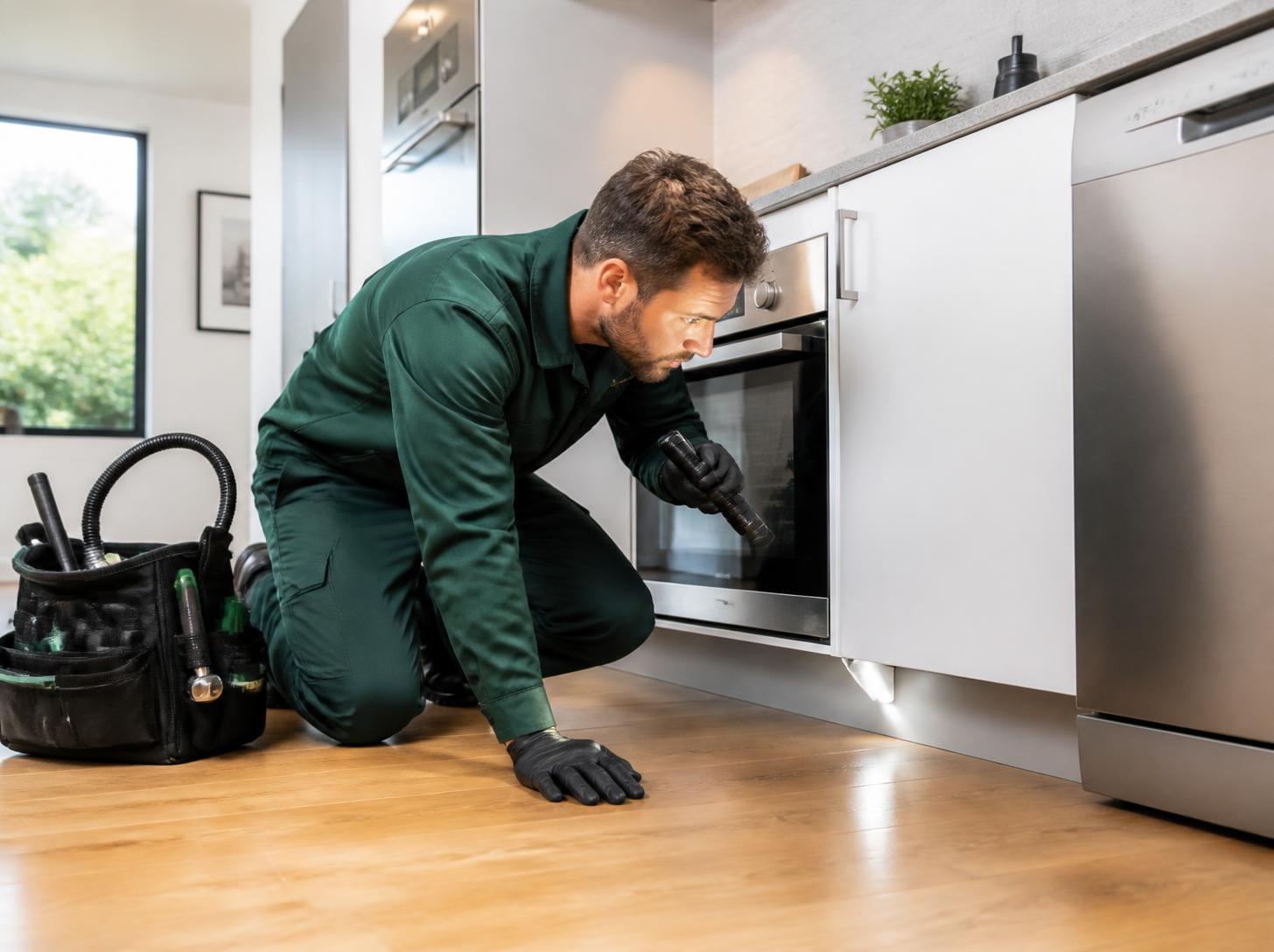
We check the roof space, the subfloor (piles, bearers, joists and the underside of the floorboards), the exterior weatherboards and any furniture you are worried about. Each area is recorded as active, historic or clear. Active means fresh flight holes with pale, clean edges, or fresh bore dust. Old damage with no fresh signs is noted and left alone.
Moisture and ventilation check
Borer larvae grow faster in damp timber, and the two-toothed longhorn is found mostly in poorly ventilated subfloors. We look for blocked vents, plumbing and roof leaks, and wet ground under the house, then tell you what to fix. Broken vent grilles are also a common way in for rodents in the subfloor, so one repair can solve two problems.
Targeted treatment
Roof voids get an aerosol treatment timed to the flight season, to knock down adult beetles before they lay eggs. Bare subfloor timber and unpainted exterior boards get a residual insecticide, sprayed or brushed on so it soaks into the surface. Furniture has its flight holes injected. Painted and varnished timber is injected rather than sprayed, because the coating stops a spray soaking in.
Structural referral where needed
If a screwdriver sinks into a bearer or joist, or a floor feels soft underfoot, treatment alone will not fix it. We tell you so, mark the timber on our report and recommend a builder or building surveyor to assess its strength. We do not carry out building repairs ourselves, and any replacement timber should be treated to the correct hazard class.
Flight-season follow-up
Larvae already inside the timber keep emerging for several seasons, so a single treatment rarely finishes the job. We recommend a follow-up treatment in the next flight season, with a re-inspection of treated areas to confirm no new holes or dust have appeared. We quote the follow-up alongside the first job, so you know the full cost from the start.
Pricing
How much borer treatment costs in Auckland
Typical range for this service is $350 – $950 including GST. We quote before we start, and the price we give you is the price you pay unless the job turns out to be materially different from what was described on the phone.
What moves the price: property size and access, how far the infestation has progressed, whether roof or subfloor work is needed, and whether follow-up visits are required to complete the job properly.
- Typical cost
- $350 – $950 incl. GST
- Call-out fee
- None
- Typical wait
- 2–4 working days
- Follow-up
- Included where the pest requires one
- Coverage
- Wider Auckland region
- Documentation
- Written record of products and placements
Where we work
Borer Treatment across Auckland
Borer is most common in older houses built from native timber or untreated pine: the villas and bungalows of the central isthmus, such as Mount Eden, Epsom and Remuera, and older North Shore suburbs like Devonport and Birkenhead.
Related reading
Guides on this pest
Questions
Borer treatment: questions people ask
How much does borer treatment cost in NZ?
Can I treat borer myself?
Do borers eat treated wood?
How serious is borer?
What kills wood borer?
Is fumigation needed for borer?
Could it be termites rather than borer?
Is borer a problem when buying a house?
When is the best time to treat borer?
More services
Other pest control services
- Residential Pest Control
- Commercial Pest Control
- Rodent Control
- Cockroach Control
- Ant Control
- Flea Control
- Bed Bug Control
- Spider & Fly Control
- Termite Inspection
- Wasp Control
- NZ Farm Forestry Association — household borer, Anobium punctatum
- NZ Farm Forestry Association — two-toothed longhorn, Ambeodontus tristis
- NZ Farm Forestry Association — powder-post beetle, Lyctus brunneus
- BRANZ — H1.2 framing timber treatment
- Standards New Zealand — key historical dates for timber treatment
- Kiwicare — borer control in timber
- Consumer NZ — borer and other pests
- EPA New Zealand — insecticides and pesticides at home
Need borer treatment in Auckland?
Describe what you have seen and we will tell you what it is likely to be, what it takes to fix, and what it will cost — before you commit to anything.
Free estimate · No obligation · Auckland-wide