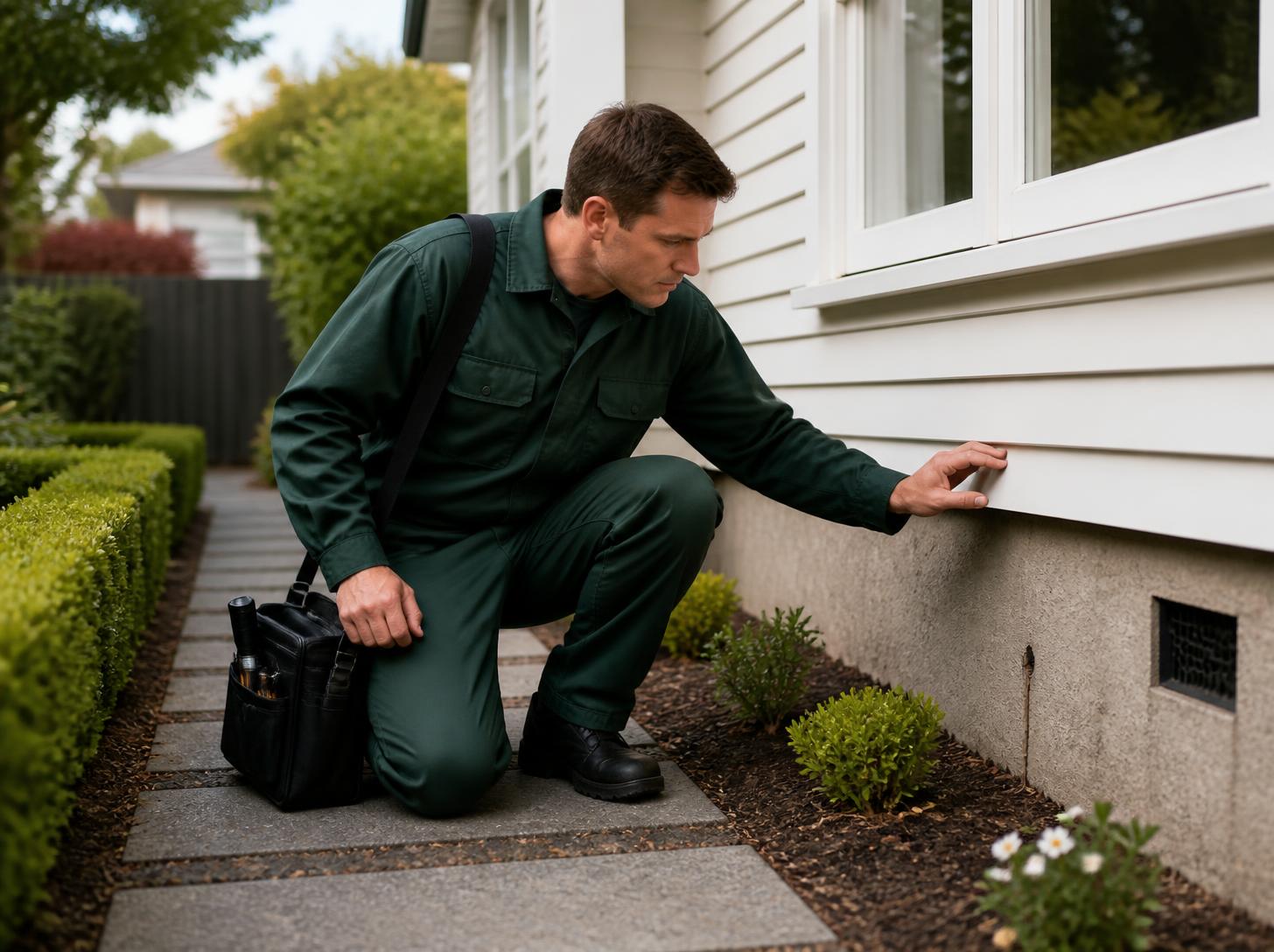
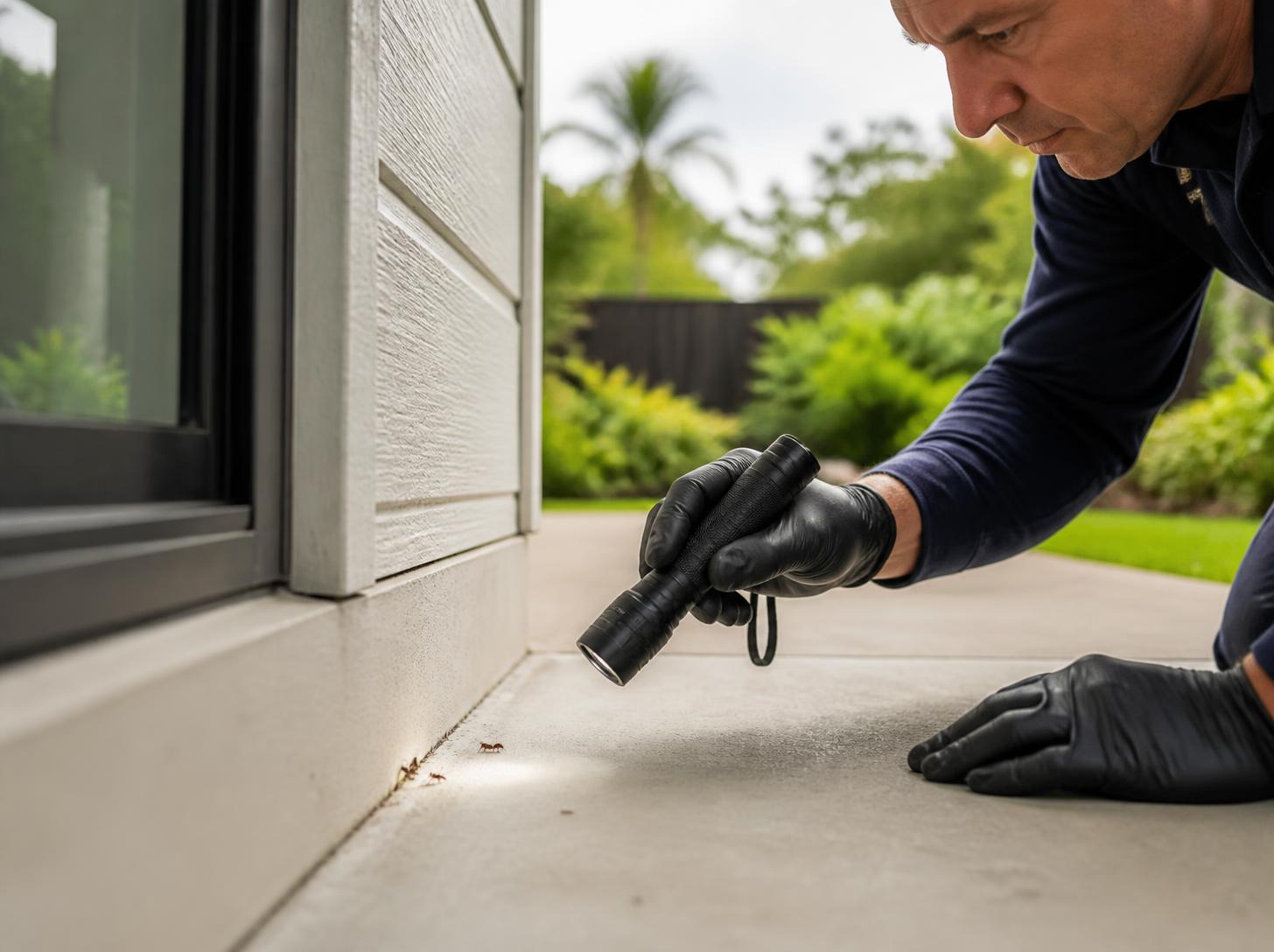
Yes, New Zealand has termites. Most people never notice them, because the native species live in small colonies inside dead branches, logs and damp, decaying wood, and they are not the house-destroying termites of Australian stories. Those do exist here from time to time, arriving in imported timber or on boats, and the Ministry for Primary Industries (MPI) treats them as an unwanted pest. If you have found something and want it identified, a termite inspection is the quickest route to an answer.
This guide explains which termites live in New Zealand, how the native species differ from the exotic ones, the signs worth taking seriously, how to tell termites from flying ants and borer, and exactly what to do if you suspect exotic termites.
Are there termites in New Zealand?
Yes. New Zealand has three native termite species: the drywood termite Kalotermes brouni and two dampwood, or wetwood, termites, Stolotermes ruficeps and S. inopinus. MPI does not regard them as destructive, and they form small colonies. Exotic termites, including the Australian subterranean termite Coptotermes acinaciformis, turn up occasionally in imported timber or on boats. MPI treats and monitors every infestation it finds.
The native drywood termite belongs to the family Kalotermitidae and is found throughout the country. The wetwood termites are mostly forest insects: S. ruficeps is widespread, while S. inopinus was only identified in 1969, near Wellington, and has since been recorded in Northland, Manawatū and Hawke's Bay. Like all termites, they feed on wood, digesting the cellulose in it with the help of microbes in their gut.
A handful of introduced Australian species that live in dead wood outdoors, such as Kalotermes banksiae and Glyptotermes brevicornis, have quietly settled in parts of New Zealand without becoming building pests, according to the NZ Farm Forestry Association (NZFFA). The species that matter are the ones that eat houses, and those are not established here.
Native termites: what they do and don't do
Native termites recycle dead wood. The drywood termite lives in dry, dead wood, including dead branches and the heartwood of living trees, and occasionally in dry timber in a building. The dampwood termites need wood that is wet and already rotting. Colonies stay small, usually no more than a few hundred termites, so damage is slow and local. In a house, they are a clue to a moisture problem rather than a threat in themselves.
The NZFFA records K. brouni in a wide range of native and exotic trees, from pōhutukawa and kōwhai to radiata pine, macrocarpa and eucalypts. Inside timber it eats out the softer bands of each growth ring, leaving long galleries between thin walls of harder wood, while the surface stays almost intact. A nest left alone for many years can weaken the piece it lives in, which is why affected timber is usually replaced.
The wetwood termites are the ones people more often find at home, in rotten framing behind a long-standing leak, in a sill that sits in wet soil, or in old fence posts and garden edging. The NZFFA puts a typical colony at 50 to 250 termites. They depend on moisture, so the fix is to stop the water, dry the area out and have decayed timber replaced. Once their wood is dry and sound, they have nothing to live on.
Exotic termites: why MPI cares, and what to do if you suspect them
Exotic termites matter because, unlike the natives, some of them destroy buildings. MPI says they can damage wood in any form, including treated timber, hardwoods and softwoods, and can live hidden in a structure for up to five years before winged adults emerge and give them away. Suspected exotic termites should be left undisturbed, photographed and reported to MPI on 0800 80 99 66.
The history in New Zealand
Australian subterranean termites were first found in Auckland in the 1930s, and the NZFFA links almost every later find to imported Australian hardwood: power and telephone poles, railway sleepers and construction timber. Between 2006 and 2015 there were incursions at nine separate locations, including Coatesville, Pukekohe, Point Wells, Drury, Māngere and Omaha in the Auckland region, and all were later declared eradicated. In 2021, some Auckland houses were found to be infested with Coptotermes acinaciformis. MPI reports that they were treated and that monitoring continues.
Drywood termites arrive a different way. The West Indian drywood termite, Cryptotermes brevis, was found in a house on the Kāpiti Coast in 2011 and eradicated by fumigating the house. Since 2020, MPI has dealt with ten infestations on boats arriving from overseas, most involving C. brevis or Incisitermes minor, the most recent in February 2026.
If you suspect exotic termites
MPI's leaflet on subterranean termites is blunt: "do not disturb them or attempt to kill them", because doing so makes eradication harder. In practice that means:
Leave it as it is
Do not spray, dig, break open timber or move infested material such as sleepers or firewood. Leave the evidence where it is for MPI's specialists.
Photograph it
Take clear photos of the insects, wings, droppings, mud or damage, with a coin or similar object for scale. MPI suggests a plain white background where possible and no zoom or filters.
Catch a sample only if it is safe and easy
A loose winged termite or a few shed wings on a windowsill can go into a sealed jar. Do not dig into timber or soil to get one.
Report it straight away
Call MPI's exotic pest and disease hotline on 0800 80 99 66, or use its online report form. A specialist will contact you.
Under the Biosecurity Act 1993, MPI expects anyone who finds an unusual organism to report it, and for organisms declared notifiable, reporting is a legal duty. This is New Zealand biosecurity working as intended: early reports are what let MPI eradicate a colony before it spreads.
Signs of termites (and what they usually turn out to be)
The signs of termites are winged swarmers or their shed wings, small hard droppings (frass) piled under tiny holes, mud tubes or mud packed into timber, and wood that sounds hollow or feels soft. Most of these have a common look-alike, so check the table before you worry. Mud tubes are the exception: treat them as a reason to call MPI.
| What you see | What it can mean | What it usually turns out to be |
|---|---|---|
| Winged insects indoors | A termite flight: alates, or swarmers, leaving a colony to mate | Flying ants, especially on warm, humid days |
| Piles of discarded wings | Termites that have landed, paired and shed their wings | Ant wings, which also drop off after mating |
| Hard pellets about 1 mm long | Drywood termite frass pushed out of tiny holes, cream to red to black | Borer dust, which is gritty powder rather than separate pellets |
| Mud tubes or mudding | Subterranean termites travelling between soil and timber | Mason wasp nests or soil splashes, but report it to MPI anyway |
| Hollow or soft timber | Galleries eaten along the grain | Wood rot from a leak, or two-toothed longhorn borer in a damp subfloor |
Check the places where timber meets soil or stays damp: the piles, foundations and bearers under the house, the base of weatherboards, decks, fences, retaining walls and landscaping sleepers. Shed wings collect on windowsills and below outside lights, since flying termites are drawn to light.
Flying termites vs flying ants
Flying termites have a thick waist, straight antennae and four wings of equal length that stick out well past the body. Flying ants have a pinched, wasp-like waist, antennae with an elbow, and front wings longer than the back ones. In Auckland homes, flying ants are far more common. One or two flying termites are not proof of an infestation, but a swarm indoors is worth checking.
| Flying termite (alate) | Flying ant | |
|---|---|---|
| Waist | Thick; the body runs straight from head to tail | Narrow and pinched |
| Wings | Four, equal in length, pale; shed soon after landing | Four, front pair longer than the back pair |
| Antennae | Straight, like a string of beads | Bent at an elbow |
| Size in NZ | About 8 mm with wings for the native drywood termite; 12–15 mm for wetwood termites; about 12 mm for the Australian subterranean termite | Varies by species |
| When they fly | Natives in late summer and autumn; exotic species generally in late spring and summer | Varies by species |
These flights are the nuptial flight: winged males and females leave the colony, pair up, drop their wings and look for a crack in suitable wood to start a new colony. The native wetwood termites do not travel far, and MPI notes that flying termites generally cover less than 100 metres. If what you have looks more like ants, our ant control page explains the common Auckland species.
Termites vs borer
Borer is by far the more common timber pest in Auckland homes. Borer beetles leave round flight holes and gritty bore dust, and their larvae tunnel through sapwood. Termites leave no round exit holes; instead you find hard pellets, shed wings or mud, and galleries that follow the grain. Borer is a beetle; termites are social insects living in a colony.
The common house borer, Anobium punctatum, is the usual cause of holes in floorboards and furniture, and its larvae spend years inside untreated timber before emerging as adults. Termites never leave the wood through neat, round holes like that. If the damage you have found comes with small round holes and fine dust, read how to identify borer before assuming termites.
The termite colony: queens, kings, workers and soldiers
A termite colony is a family run by a king and a queen, the pair that founded it after their nuptial flight. The queen lays the eggs and the king stays with her, mating for life. Workers or immature termites feed the colony and tend the young, and soldiers with large heads and strong jaws guard it. Winged alates are produced when the colony is ready to spread.
In the native drywood termite, most of the work is done by immature termites rather than a separate worker caste. The NZFFA describes its soldiers as having dark red heads almost twice as long as they are wide, with robust black jaws. In the Australian subterranean termite, soldiers are 5–7 mm long with brown heads and long jaws, and the workers are white.
How long does a queen live? The Australian Museum says queens can live and reproduce for up to 20 years in some species, and longer figures are reported for others. Nobody knows how long a native New Zealand queen lives; the NZFFA notes that lifespans for K. brouni are unknown.
Can a colony survive without its queen? Often, yes. When the queen dies or a colony splits, some immature termites can develop into replacement reproductives and take over. Can you tell if a termite is a queen? In large colonies of some species her abdomen swells to many times its original size, but she stays deep inside the nest, so you are very unlikely ever to see one.
Do termites bite or harm people?
No, not in any way that matters. Termites are not blood feeders and are not known to spread disease to people. A soldier can give a small nip if you pick it up, since its jaws are built for defending the colony, but it is harmless. Flying termites have no sting and are not known to bite. The risk termites pose is to timber, and for native species even that is small.
Unsure what you have found?
Most suspected termites in Auckland turn out to be flying ants, borer or wood rot, and native termites in damp wood are a moisture problem with a straightforward fix. To have it identified, book a termite inspection and you will get a written answer on what it is and what to do. If anything looks like exotic termites, especially mud tubes or termites around imported hardwood, leave it alone and call MPI on 0800 80 99 66 first.
For anything else, call 09 925 0448 or request an estimate online.
Frequently asked questions
Do termites live in Auckland?
Yes. Native termites occur throughout New Zealand, Auckland included, living quietly in dead branches, logs, stumps and damp, decaying wood. Destructive exotic termites are not established here. Australian subterranean termites have been found at Auckland properties several times, most recently in houses in 2021, and each time MPI has treated the site and monitored it. If you think you have found them, report it rather than treat it.
Why do termites appear after rain?
Flights are timed to the weather. Winged termites leave the colony in warm, humid conditions, which often follow rain, and the Australian Museum notes that flights happen in warm, humid weather. MPI's leaflet notes that Australian subterranean termites fly on warm, humid evenings and are drawn to lights. New Zealand's native termites fly in late summer and autumn. A sudden appearance usually means a flight, not a new infestation overnight.
Are termite mounds found in New Zealand?
No. The termites found in New Zealand nest inside the wood they feed on or, for subterranean species, in timber and the soil beneath it, so you will not see the tall earth mounds shown in pictures from Australia and Africa. Those are built by tropical and Australian species. If you see a hard mound of soil against a house, a sleeper or a tree, photograph it and ask MPI.
Does NZ timber treatment protect against termites?
It helps, but it is not a guarantee. Under NZS 3640, treated timber is preserved against insect attack and decay, and boron-treated H1.2 framing is the minimum for radiata pine framing. That should make damage by native termites and borer unlikely in sound, dry treated timber. MPI warns, though, that exotic termites can attack treated timber as well as untreated wood, so treatment is no reason to ignore signs of them.
What smell do termites hate?
There is no good evidence that any smell, oil or home remedy keeps termites away from a building. Orange oil, vinegar, neem and similar remedies are often suggested, but none replaces keeping timber dry and off the soil. For native termites in damp wood, fixing the moisture is what works. For suspected exotic termites, any DIY attempt disturbs the colony, which MPI says makes eradication harder, so report them instead.
Can I spray termites myself?
For native dampwood termites in rotten timber, spraying achieves little: the answer is to dry the area out and have the decayed wood replaced. For anything that might be exotic, do not spray at all. MPI's advice is that disturbing or trying to kill suspected exotic termites makes eradication by its specialists harder. Photograph what you see, note where it is, and call MPI on 0800 80 99 66.
- Ministry for Primary Industries — Exotic termites: treating and monitoring infestations
- Ministry for Primary Industries — Report a pest or disease
- MPI leaflet via Canopy (Te Uru Rākau) — Have you seen signs of termites?
- Canopy — Pests, including borer and termites
- NZ Farm Forestry Association — New Zealand drywood termite, Kalotermes brouni
- NZ Farm Forestry Association — New Zealand wetwood termites, Stolotermes
- NZ Farm Forestry Association — Australian subterranean termites in New Zealand
- NZ Farm Forestry Association — Pest status of exotic termite species in New Zealand
- Manaaki Whenua Landcare Research — Termites
- Te Ara — Native termite
- Australian Museum — Termites
- University of Maryland Extension — Ants and termites: how to tell the difference
- BRANZ — Timber treatment