Borer is the most common timber pest in New Zealand houses, and the most over-diagnosed. Almost every villa and bungalow in Auckland has flight holes somewhere, and many were made by beetles that died long before the current owners moved in. The useful questions are which beetle made them, and whether it is still active.
This guide answers both: what borer looks like, where to look, how to tell fresh damage from old, when the beetles fly, and what a "borer present" note means when you are buying. If you already know it is active, borer treatment covers how we deal with it and what it costs.
What is borer?
Borer is the New Zealand name for the larvae of wood-boring beetles, which tunnel through timber as they feed. In most homes it means the common house borer, Anobium punctatum, known in Britain as the furniture beetle or woodworm. You rarely see the insect itself. You see what it leaves: small round flight holes and little piles of fine dust where adult beetles have chewed their way out.
The life cycle runs egg, larva, pupa, adult. Females lay small white eggs in cracks, on rough-sawn surfaces and in old flight holes, which is why the same piece of timber is reinfested year after year. The eggs hatch after four to five weeks and the larvae bore straight in. For the next three to four years they tunnel along the grain, mostly through the sapwood, packing the tunnels behind them with bore dust. Each larva then pupates inside the wood, and the adult beetle chews out through the surface, leaving a flight hole. It lives for up to about four weeks, long enough to mate and lay the next generation.
So the holes are the smallest part of the damage. Each one marks a single beetle leaving. Behind it are years of tunnels you cannot see.
What does borer look like in NZ?
The common house borer is a small reddish to dark brown beetle, about 2.5–5 mm long, and its flight holes are round and 1–2 mm across. The larvae are pale, curled grubs you will only see if you break timber open. Two other beetles damage New Zealand buildings, and one large native beetle is often mistaken for them. The table shows how to tell the four apart.
| Beetle | Adult size | Flight or exit holes | Bore dust (frass) | Timber attacked |
|---|---|---|---|---|
| Common house borer Anobium punctatum | 2.5–5 mm | Round, 1–2 mm | Fine and gritty, in small piles | Sapwood of untreated timber: radiata pine, rimu, kahikatea, furniture |
| Two-toothed longhorn Ambeodontus tristis | Up to 25 mm | Oval, about 3–7 mm long | Packed tightly into the tunnels, so little falls out | Sapwood and heartwood of rimu, kahikatea and macrocarpa, mostly in damp subfloors |
| Powderpost beetle Lyctus brunneus | Up to about 7 mm | Round, under 2 mm | Very fine and soft, like talcum powder | Sapwood of hardwoods: tawa, rewarewa, oak, ash, elm |
| Huhu beetle Prionoplus reticularis | 40–50 mm | Oval, 10–20 mm | Coarse, packed pellets | Damp, dead or rotting wood: logs, stumps, firewood |
The two-toothed longhorn is native, and it is the one that does structural harm. It is a longhorn beetle, with antennae much longer than the house borer's, and its larvae can spend years inside a single bearer. Because it tunnels through heartwood as well as sapwood, severe infestations can leave a joist as a thin outer shell. Untreated rimu under a damp, poorly ventilated floor is where it is usually found.
The powderpost beetle matters less in New Zealand, because it only attacks hardwoods and most houses are framed in softwood. It turns up in hardwood furniture, joinery and flooring.
The huhu is included for contrast. It is huge, it lives in damp dead wood outdoors, and it is not a house pest. If you have found a big beetle or a fat grub in the firewood, read about huhu beetles instead.
Signs of borer in your house
The signs are flight holes, small piles of bore dust, beetles on windowsills in early summer, and timber that crumbles at the edges. Look where timber is untreated, unpainted and slightly damp: the subfloor, the roof space, the lower weatherboards, window joinery, stairs and old furniture. In painted rooms, borer is often active behind the surface for years before anything shows.
- Flight holes. Small, round and clean-edged for house borer; larger and oval for the two-toothed longhorn.
- Bore dust (frass). Little cones of fine, gritty dust on the floor, a windowsill, a stair tread or a joist below the holes.
- Beetles in the flight season. Small brown beetles on windowsills or caught in cobwebs from about October to February.
- Crumbling edges. Floorboard edges, skirting or furniture legs that break up into powder when pressed with a screwdriver.
- Soft or springy floors. Usually over a damp subfloor, and worth a closer look at the framing underneath.
- A damp subfloor. Wet ground, blocked vents or a plumbing leak make borer more likely and make its larvae grow faster.
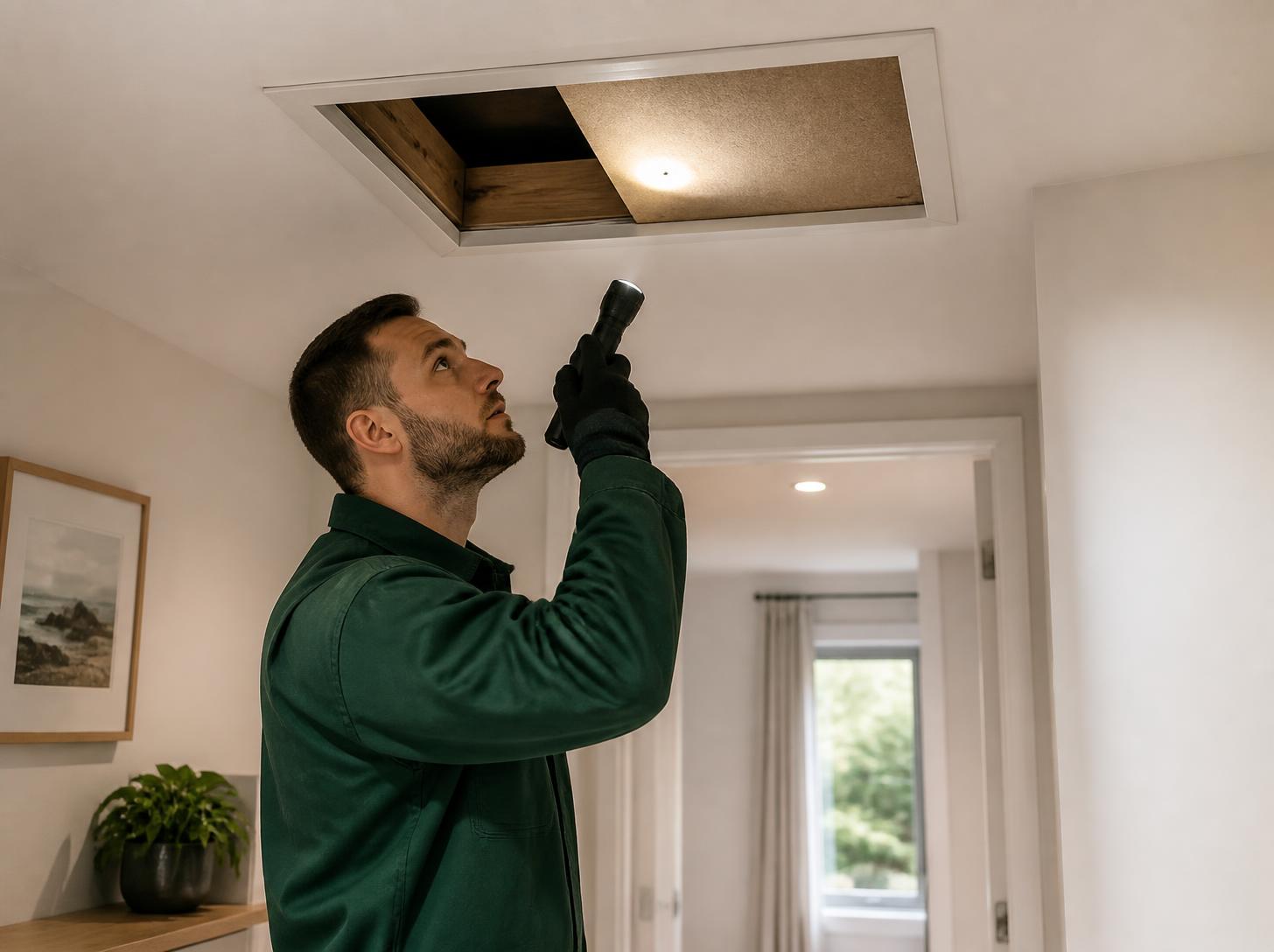
Where to look. Start in the subfloor, with a torch: the piles, the bearers and joists, and the underside of the floorboards. Then the roof space, especially the rafters and ceiling joists nearest the eaves. Outside, check the lowest weatherboards, which stay damp longest. Paint hides a lot. A weatherboard can show a few holes on its face while its back is riddled. Indoors, check window frames, stair treads, built-in cupboards and any antique or second-hand furniture.
How to tell if borer is active
Active borer leaves fresh evidence: flight holes with sharp, pale edges and clean wood inside, and bore dust that is pale, gritty and comes back after you clean it away. Old holes are dark and dirty, and are often filled with paint, dust or cobweb, with nothing new appearing below them. The surest test is to mark or clean an area before the flight season and check it again afterwards.
Fresh holes and old holes
A fresh flight hole looks as if it was drilled yesterday: a crisp edge and bright, pale wood inside. An old hole has a rounded, darkened edge and grey wood inside, and if the timber has been painted since, the paint runs into it. A surface covered in old, painted-over holes with no clean ones is almost certainly historic damage.
Fresh dust
Fresh frass is pale, the colour of the timber, and sits in a small neat pile or cone. Old dust is grey, spread out and mixed with dirt. The easiest test is to vacuum or brush the area clean and look again in a few weeks during the flight season. Dust that reappears means something is still chewing.
The mark-and-check test
Clean the area in spring
Before October, vacuum away all old dust from the timber you are worried about and the surface below it.
Mark or cover the existing holes
Tape a sheet of paper over a section, fill the old holes with wax or filler, or photograph the area with a coin beside it for scale.
Check after the flight season
In February or March, look for any new hole through the paper, any unfilled hole, or any new hole in the photo, and for fresh dust below.
Read the result
One new hole means the timber is active. None, over a full season, is good evidence the damage is historic.
If you cannot wait a season, or cannot reach the timber, a professional inspection does the same job in an afternoon, and records which areas are active, historic or clear.
When do borer fly in NZ?
The common house borer flies from about October to February, with most adults emerging between November and January. They live only a few weeks, mating and laying eggs in that time. The two-toothed longhorn is different, emerging in autumn and early winter, and powderpost beetles appear mainly in October and November. Timing matters, because treatment works best against emerging adults and freshly laid eggs.
That is why the flight season is when you notice borer, with beetles on the windowsills and new dust under the holes, and it is also why treatment timed to the flight season does far better than a spray at a random time of year. A residual treatment on bare timber in early spring is already in place when the beetles come out and go looking for somewhere to lay.
Is borer damage serious?
Usually not in the short term. House borer works slowly, and a scatter of holes in floorboards or skirting is mostly cosmetic. It becomes structural when load-bearing timber, such as piles, bearers, joists or wall framing, has been tunnelled so heavily that it has lost strength. That takes many years, and it is usually found with damp. A builder or building surveyor should judge strength, not a pest technician.
Signs that it is worth getting a builder in: a screwdriver sinks easily into a bearer or joist, the timber sounds hollow when tapped, a floor sags or springs underfoot, or the surface breaks away to show a mass of tunnels. The two-toothed longhorn is the usual cause of that level of damage, in untreated rimu subfloors. A house with borer is not unsafe by default, but weakened structural timber should be assessed before it is treated, because treatment kills insects and does not restore strength.
Borer and buying a house
Borer is common in Auckland villas and bungalows, so a pre-purchase report noting "borer present" is normal rather than alarming. What matters is whether it is active or historic, which timbers are affected, and whether any load-bearing timber is weakened. Put those three questions to the inspector in writing. Historic damage in floorboards may need nothing at all. Active borer in subfloor framing is worth pricing before you negotiate.
In the older suburbs, many houses are built from native timber over open subfloors. Among the villas in Mount Eden, for example, some historic borer is close to universal. The questions worth asking:
- Active or historic? Did the inspector see fresh holes or fresh dust, or only old holes?
- Which timbers? Floorboards and skirting are one thing; piles, bearers and joists are another.
- Structural or cosmetic? Was any framing probed, and did it feel sound?
- Why is it there? Is the subfloor damp or poorly ventilated? That affects what happens next.
If the answers are vague, a separate borer inspection before settlement is inexpensive compared with the cost of finding active longhorn in the bearers after you move in.
Borer vs termites in NZ
New Zealand has three native termite species, including the drywood termite Kalotermes brouni, and none is considered destructive to houses. Exotic termites are another matter: MPI treats them as unwanted pests, and Australian subterranean termites were found in some Auckland houses in 2021. Borer is far more common, but if you suspect termites, report them rather than treat them yourself.
The evidence looks different. Borer leaves round holes and gritty dust. Termites push out droppings as separate hard pellets about 1 mm long, cream to reddish to black, which pile up directly under tiny holes in the wood. You may also find discarded wings from winged termites, which fly in late spring and summer. If you see either, leave it undisturbed, photograph it and call MPI's exotic pest and disease hotline on 0800 80 99 66. Our guide to termites in New Zealand explains the native species and how to tell termites from flying ants.
Do borers eat treated timber?
Borer rarely damages properly treated timber. Pine framing in New Zealand is boron-treated, now specified as hazard class H1.2 under NZS 3640, which requires the preservative to penetrate the sapwood completely. The timber at risk is untreated: native timber in houses built before boron treatment began in the 1950s, and untreated kiln-dried framing used in some homes between the late 1990s and 2004.
H1.2 framing is tinted pink and branded with the hazard class, so it is easy to recognise where you can see it. Boron is water-soluble, which is why builders keep treated framing dry during construction; timber that stays wet for long periods can lose some protection. For repairs, use timber treated to the right hazard class for where it is going, not untreated offcuts.
Found fresh activity?
If the mark-and-check test or an inspection shows active borer, the next decision is whether to treat it yourself. For bare timber you can reach and small furniture, DIY can work if it is done at the right time of year. For roof voids, subfloors and anything structural, it is harder. Our guide to DIY options and their limits goes through borer bombs, sprays, injection and the home remedies to avoid.
If you would rather have it checked, call 09 925 0448 or request an estimate online. Tell us where you have seen holes or dust and whether it is new, and we will tell you what an inspection involves.
Frequently asked questions
Is woodworm the same as borer?
Yes. Woodworm is the British name for the larvae of the same beetle, Anobium punctatum, which New Zealanders call the common house borer and the British call the common furniture beetle. People also use it loosely for any wood-boring grub. Advice written for woodworm in the UK mostly applies here, but the flight-season months are reversed and the products sold are different.
What does borer dust look like?
House borer dust is fine, pale and gritty when you rub it between your fingers, and it collects in small piles or cones under flight holes. Powderpost beetle dust is much finer and softer, closer to flour or talcum powder. Termite droppings are different again: separate hard pellets about 1 mm long. Fresh dust is pale and clean, while old dust is grey and mixed with dirt.
Can borer spread from furniture to the house, or the other way?
Yes, in both directions, provided the timber is untreated. Adult beetles fly and lay eggs on any suitable wood they reach, so an infested antique chest can seed floorboards and skirting, and a house with active borer can infest furniture. Check second-hand furniture for fresh holes and dust before it comes inside, and treat or isolate anything that shows activity.
Do borer bite?
No. Adult borer beetles do not bite or sting people or pets, and they carry no disease. They are small, slow and live only a few weeks, and the only thing they harm is timber. The large native huhu beetle can give a painful nip if it is handled roughly, but that is a different insect and it is not a house pest.
How long do borer larvae live in wood?
Years. Common house borer larvae typically spend three to four years in the timber, according to the NZ Farm Forestry Association, and they develop faster in damp wood. The two-toothed longhorn can take anywhere from two to eleven years. That long hidden stage is why new flight holes can keep appearing for several seasons after a treatment.
Does every old villa have borer?
Most have some historic damage, because they were built from untreated native timber long before boron treatment was introduced. That is not the same as having active borer. Plenty of villas carry flight holes that are decades old in the floorboards and subfloor, with nothing living behind them. A careful inspection separates active from historic, and only the active areas need treating.
- NZ Farm Forestry Association — household borer, Anobium punctatum
- NZ Farm Forestry Association — two-toothed longhorn, Ambeodontus tristis
- NZ Farm Forestry Association — powder-post beetle, Lyctus brunneus
- Manaaki Whenua Landcare Research — identification
- BRANZ — H1.2 framing timber treatment
- Standards New Zealand — key historical dates for timber treatment
- Consumer NZ — borer and other pests
- Ministry for Primary Industries — exotic termites