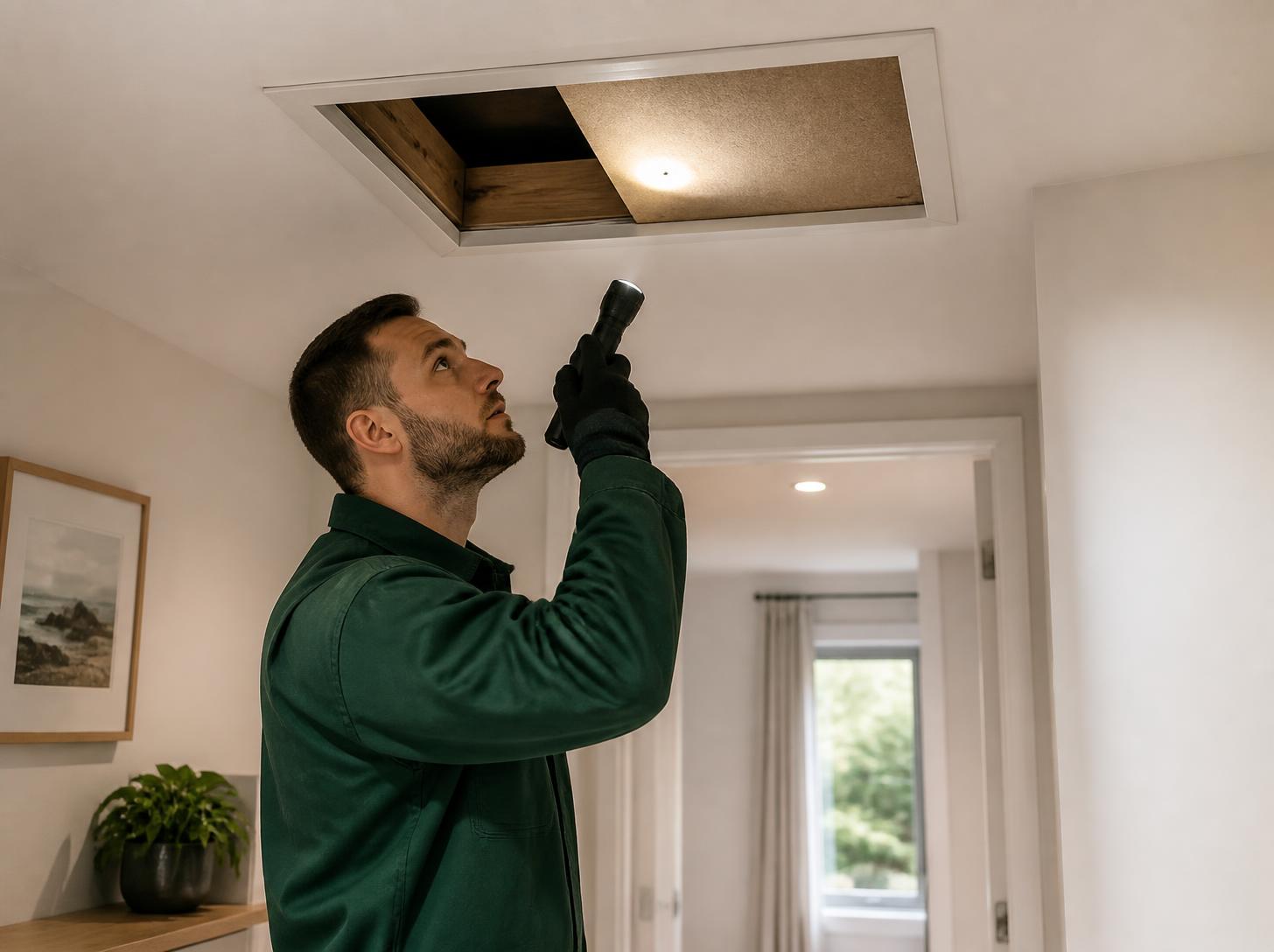
It is the single most common reason people call us. Somewhere between nine and eleven at night, the scratching starts overhead — a quick scurry across the ceiling, a pause, then a persistent gnawing sound directly above the bedroom. You lie there working out whether it is your imagination.
It is not your imagination, and in Auckland it is almost always a ship rat (Rattus rattus). Here is how to be sure, what it tells you about the scale of the problem, and what actually resolves it, whether you tackle it yourself or book rat control in Auckland.
What the sound tells you
Before anything else, work out what you are listening to. Three things get into Auckland roof spaces and they sound distinctly different.
| What you hear | Most likely | Why |
|---|---|---|
| Fast, light scurrying; scratching; persistent gnawing | Ship rat | Nocturnal, active from just after dark, constantly gnawing to wear down teeth |
| Very faint scratching, more like rustling paper | House mouse | Much lighter — often only audible in a quiet room |
| Heavy, slow thumps you can feel; hissing and coughing | Possum | 2–4 kg animal; the vocalisations are unmistakable once heard |
| Fluttering, chirping, activity at dawn | Birds | Starlings and mynas nest in soffits and are active at first light, not after dark |
Timing matters as much as volume. Rodents start shortly after dark and are busiest in the first two or three hours. Birds are the opposite — quiet all night, then active at dawn. If you are hearing noise at 5:30am and silence at 10pm, stop worrying about rats and look at your soffits.
Why it's almost always a ship rat
New Zealand has three rat species, but only two turn up in Auckland houses, and they behave completely differently.
The ship rat — also called the black rat or roof rat — is a superb climber. It travels through tree canopy, along fence lines, up rough weatherboard, over power lines and down downpipes. It enters buildings at roof level and nests in ceiling cavities, wall voids and roof spaces. It is slim, with a tail longer than its body and noticeably large, thin ears. The Department of Conservation describes it as the most widespread rat in New Zealand, and in urban Auckland it dominates.
The Norway rat (Rattus norvegicus) is bigger, heavier and a ground dweller. It burrows, swims well and uses drainage networks. Blunter nose, smaller ears, tail shorter than its body. If you have Norway rats you will usually find them at ground level, in the subfloor, or coming up through compromised drainage — not running along your ceiling joists.
This distinction is not academic. It determines where we place treatment and where we look for entry points. Properties near tidal margins and stormwater — Te Atatū, Onehunga, Pakuranga — see far more Norway rat work. Bush-edge suburbs like Birkenhead, Glenfield and Henderson are overwhelmingly ship rat territory.
Confirming it before you spend money
Sound alone is suggestive. These confirm it:
- Droppings. Rat droppings are 12–18 mm, dark, spindle-shaped with pointed ends. Mouse droppings are 3–6 mm, like coarse grains of rice. Look along ceiling joists, in the insulation near the hatch, and on top of wall plates.
- Smear marks. Rats follow the same routes repeatedly and the oils in their fur leave dark greasy marks along joists, pipe runs and beam edges. These are one of the most reliable indicators of an established route.
- Gnawing. Chewed cable sheathing, gnawed timber edges, damaged pipe lagging. Rat incisors grow continuously and they gnaw constantly to manage it.
- Disturbed insulation. Tunnels and hollows in ceiling batts, or shredded paper and fabric gathered into a nest.
- Smell. An established population produces a distinctly stale, musky ammonia odour. Once you have smelled it in a roof space you do not mistake it again.
Our guide to the nine signs of a rodent problem goes through each of these in more detail, including how to read what the quantity of droppings tells you about population size.
Are rats in the roof dangerous?
They are a genuine health risk and a property risk, though rarely an emergency. Rats gnaw constantly, and chewed electrical cabling in a ceiling is a recognised cause of house fires. Their urine and droppings contaminate insulation and anything stored in the roof. And rodents carry disease: Health New Zealand notes that leptospirosis spreads through infected animals' urine, and rodent droppings can spread salmonella to food and surfaces.
The disease risk is mostly about contact rather than rats simply being overhead. It matters most when droppings end up in a pantry or on benches, or when someone handles contaminated insulation without gloves. The fire risk is the one people underestimate. University of California IPM advisers note that rodents gnawing on wiring are believed to cause many fires of unknown origin. That is why a roof-space inspection includes looking at cable sheathing, not just counting droppings.
Safety note. If you go into the roof space yourself, wear a P2 mask and gloves, and do not disturb droppings any more than you have to. Dried rodent droppings and urine can aerosolise. Watch your footing — step on the joists, never on the ceiling lining between them.
How they're getting in
This is the part that decides whether the problem returns next year, and the part most commonly skipped. A rat needs a gap of only about 12 mm; a mouse needs about 6 mm. In Auckland housing, the usual entry points are:
- The roof-to-wall junction. Where the roof meets the top of the wall there is often a gap behind the fascia or under the bottom course of tiles. This is the single most common ship rat entry we find.
- Overhanging vegetation. Any branch touching or within about a metre of the roofline is a bridge. Ship rats jump roughly a metre horizontally.
- Corroded or damaged subfloor vents. Especially on coastal properties in Devonport, Takapuna and around the harbour edges, where salt air eats through steel mesh over a couple of decades.
- Unsealed service penetrations. Where pipes, cables and vents pass through walls. Renovations are a frequent culprit — a new bathroom waste installed through an old wall, with a 30 mm gap around it that nobody filled.
- Eaves and soffit gaps. Particularly where a soffit lining has warped, dropped or been damaged.
- Broken or missing gully trap seals. More a Norway rat route, but worth checking when rodents appear indoors with no visible external entry.
Why DIY often disappoints
Supermarket snap traps and bait blocks are not useless — but there are three reasons they frequently fail in a roof space.
Rats are neophobic. They are genuinely wary of new objects in an established territory and will often avoid a new trap or bait station for several days. People conclude it is not working and move it, restarting the clock. Mice are the opposite — actively curious — which is why mice are usually easier to trap than rats.
Placement beats quantity. Rats travel along edges and structural lines, rarely across open spaces. A trap in the middle of a roof space catches nothing. A trap set hard against a joist on an active run, perpendicular to the travel direction, catches quickly. Without reading the smear marks you are guessing.
Nothing gets sealed. This is the big one. You can remove every rat in the roof and have a fresh one in from the neighbour's hedge within a fortnight, because the entry point is still open. Treatment without proofing is a subscription, not a solution.
If you want to try it yourself first, our guide to which rat traps and baits work, and where to put them covers trap types, placement and bait safety.
What a proper job looks like
When we attend a roof rat job in Auckland, the sequence is:
- Inspect the roof space, subfloor and perimeter. Identify the species, read the smear marks and droppings to map active runs, and locate the nest area.
- Map every entry point. Externally as well as internally — vegetation contact, roof junction, vents, penetrations. Written down, in priority order.
- Place treatment on the active runs. Tamper-resistant lockable bait stations, or trapping where a household prefers no toxicant or where a cavity death would be problematic.
- Give you the proofing list. What to seal, what to trim, what to repair. Some of it you can do in an afternoon; some needs a builder.
- Return to verify. Check uptake, confirm activity has stopped, close out remaining gaps.
Typical cost for this in Auckland is $180 to $350 including GST, including the follow-up. Full detail is on our cost guide and the rodent control service page.
How long until it's quiet again
Activity usually drops noticeably within 3 to 7 days and stops within 2 to 3 weeks. The lag is mostly that neophobia — expect a few days of apparently nothing happening before uptake begins.
Be aware there may be an odour if a rodent dies in an inaccessible cavity, typically lasting one to three weeks. We reduce that risk with placement, and where a cavity death would be particularly awkward we will use trapping instead. Anyone who tells you this never happens has not done many roof jobs.
Stopping it happening again
Rodent pressure in Auckland is seasonal and predictable. Activity climbs sharply from March as outdoor food dries up and nights cool, peaking through April and May. That means the useful work happens in late summer, not mid-winter.
- Cut all vegetation back at least a metre from the roofline
- Seal gaps over about 6 mm; use steel wool or metal mesh, not expanding foam, which rats chew through
- Replace corroded subfloor vent grilles
- Secure compost, pet food and fallen fruit
- Check gully trap seals are intact
Our rodent-proofing checklist works through this in order of what actually pays off, and the Auckland pest calendar shows how the seasonal pattern runs across the year.
One honest caveat. If your property backs onto bush, reserve or a gully — common across the North Shore and West Auckland — the reservoir next door is permanent and no treatment will change that. The realistic goal is a well-sealed building and a maintained external line, not permanent eradication. Anyone promising otherwise is guessing.
Frequently asked questions
How do I know if it's rats or possums in my roof?
Weight and rhythm are the giveaway. Rats sound like quick, light scurrying with intermittent scratching and gnawing — a rapid patter that starts and stops. Possums are much heavier, producing slow, deliberate thumps you feel as well as hear, plus loud vocal hissing and coughing. If it sounds like someone dropped a shoe, it is not a rat.
Why do I only hear them at night?
Ship rats are nocturnal and become active shortly after dark, typically peaking in the first two to three hours. If you are hearing significant daytime activity, that usually means either a large population competing for food, or that something has disturbed the nest.
Can rats get in through the roof if there are no trees near my house?
Yes. Ship rats climb rough weatherboard, downpipes, cables and fence lines, and they can jump about a metre horizontally. Overhanging branches make it easier but are not required. We regularly find entry at the roof-to-wall junction on properties with nothing overhanging at all.
Is it dangerous to have rats in the ceiling?
It is a real risk rather than an emergency. Gnawed wiring can start a fire, and urine and droppings contaminate insulation and can carry disease, including leptospirosis. The section above on whether rats in the roof are dangerous covers each risk. None is cause for panic, but none is a reason to leave rats in the ceiling for a few months either.
How much does it cost to get rid of rats in the roof in Auckland?
A standard residential rodent treatment runs $180 to $350 including GST, covering inspection, treatment and one follow-up. Larger properties or difficult roof access run higher. See our Auckland pest control cost guide for full ranges.
What is the fastest way to get rid of rats in the ceiling?
Snap traps set against the joists on the runs marked by droppings and smear marks, with the entry point sealed at the same time. Traps work the night a rat steps on one, while rodenticide takes several days. Leave traps baited but unset for a few nights first, because roof rats avoid new objects. Sealing the gap is what stops the next rat replacing the one you caught.
How long can a rat live in a roof?
Indefinitely, as a population. Individual ship rats rarely live long: Predator Free NZ notes that most wild rats do not survive beyond a year. But a roof void or attic with warmth, nesting material and food within reach supports breeding, so rats born there replace the ones that die. A roof that has had rats for years has usually had several generations of them.
Will rats eventually leave on their own?
No. A roof space gives them warmth, dry insulation to nest in and shelter from predators, and the food they need is usually close by in the garden, the compost or the neighbourhood. Nothing about that changes unless you change it. Activity may drop in summer when outdoor food is plentiful, but the rats that nested there generally stay, and they are back in force in autumn.
- Department of Conservation — rats in New Zealand
- Predator Free NZ — rodent control guidance
- Manaaki Whenua Landcare Research — identification
- EPA New Zealand — insecticides and pesticides at home
- Health New Zealand — Leptospirosis
- US CDC — Rodent control
- UC IPM — Rats (pest note)
- Predator Free NZ — The secret life of urban rats