By the time you see a rat crossing the kitchen floor in daylight, the problem has been running for a while. Rodents are nocturnal and avoid people — a daytime sighting usually means the population has grown enough that individuals are being pushed out of hiding.
These are the earlier signals, what each one tells you about how far along it is, and when it is time to call in professional rodent control.
Why do rats suddenly appear in your house, and what attracts them?
Usually because something changed outside. In Auckland the big trigger is autumn: outdoor food dries up and nights cool, so rats move towards warmth and reliable food from March onwards. Building work next door, land clearing, a neighbour's rat problem being treated, or a new food source such as a compost bin, a chicken run or pet food left out can all push rats towards your house within days. Overgrown vegetation against the walls and roofline gives them cover and a way up.
What keeps them there is food, water and shelter, in that order, which is why good food storage matters. Rodent droppings near food are also a health risk: the US CDC lists salmonella among the diseases rodents spread through contaminated food. And how they get in is almost always the same: entry points they found while exploring, such as a gap at the roof line, a corroded subfloor vent or an unsealed pipe penetration. Rats rarely arrive out of nowhere. They arrive because a gap and a reason lined up.
1. Droppings — the most useful evidence
The single most informative thing you can find, because size identifies the species and quantity indicates scale.
| Species | Size | Shape | Where |
|---|---|---|---|
| Rat | 12–18 mm | Spindle-shaped, pointed ends, dark | Ceiling joists, along walls, near food, in roof space |
| Mouse | 3–6 mm | Like a coarse grain of rice, pointed | Drawers, cupboards, behind appliances, along skirtings |
Reading the age: fresh droppings are dark, slightly moist and soft. Older ones turn grey, dry out and crumble when pressed with a stick. A mix of both means ongoing activity rather than a single visitor.
Reading the scale: a rat produces roughly 40 droppings a night; a mouse, 50 to 80. A handful in one spot suggests light or recent activity. Dozens across several locations means an established population.
Handle with care. Do not sweep or vacuum dry droppings — it can aerosolise particles. Ventilate the area, wear gloves and a P2 mask, dampen the material with disinfectant first, then wipe up and bag it.
2. Smear marks along their routes
Rodents are creatures of habit and use the same runs repeatedly. Oils and dirt in their fur transfer to surfaces, leaving dark greasy marks along ceiling joists, pipe runs, beam edges, skirtings and the sides of gaps they squeeze through.
These are one of the most valuable things a technician looks for, because they map the active routes — which is where treatment needs to go. Well-developed smears take weeks to form, so their presence indicates an established population rather than a recent arrival.
3. Gnawing and damage
Rodent incisors grow continuously and must be worn down, so rats and mice gnaw compulsively with their teeth — including on things with no nutritional value.
- Chewed electrical wiring. The most serious finding. Damaged cable sheathing in a ceiling is a genuine fire risk and should not be left.
- Gnawed food packaging. Small ragged holes in boxes, bags and containers.
- Damaged timber. Chewed edges on joists, door frames, skirtings and cupboard corners.
- Chewed plastic and pipe lagging. Including irrigation lines and pipe insulation.
Rat gnaw marks are around 4 mm wide with visible parallel incisor grooves; mouse marks are much finer, roughly 1 mm.
4. The smell
An established population produces a distinctly stale, musky ammonia odour from accumulated urine. It is most obvious in enclosed spaces — roof spaces, subfloors, cupboards, wall cavities — and is strongest near the nest.
A sudden strong smell of decay is different: that is usually a rodent that has died in a cavity, sometimes after someone has put out bait.
5. Sounds at night
Scratching, scurrying and gnawing, starting shortly after dark and typically peaking in the first two or three hours.
- Rats: quick, light patter with intermittent scratching and gnawing
- Mice: much fainter, more like rustling paper, often only audible in a quiet room
- Possums: heavy, slow thumps you can feel, plus loud hissing and coughing
- Birds: fluttering and chirping at dawn, not after dark
Our guide to scratching in the ceiling at night goes through how to tell each noise apart.
6. Nesting material
Rodents shred soft material to build nests — insulation batts, paper, cardboard, fabric, string. Look for shredded material gathered into hollows in roof space insulation, in the backs of rarely-opened cupboards, in stored boxes, or in the back corners of garages and sheds.
A nest indicates breeding, not just passage. That is a meaningful escalation — it means the population is producing more rather than simply passing through.
7. Your pet's behaviour
Cats and dogs detect rodents long before people do. Watch for an animal fixating on one spot — a wall, a ceiling area, the back of a cupboard, a subfloor hatch — repeatedly and for no visible reason. Sitting and staring, scratching at a skirting, pacing along one wall, or sudden alertness at the same time each evening.
It is not conclusive, but when a technician arrives and the owner says "the dog has been obsessed with that corner for a fortnight", that corner is where we start.
8. Runways and rub marks outside
Rodents travel along edges, not across open ground. Outdoors, look for:
- Worn trails through long grass or ground cover, particularly along fence lines and foundations
- Burrow entrances near foundations, under decking, beside compost bins or in banks — typically 50–80 mm across for Norway rats
- Greasy rub marks where they squeeze under a gate, through a fence gap or past a downpipe
- Disturbed compost, or fallen fruit that is being consistently taken overnight
These trails usually lead straight to the entry points. Finding this outside gives you the chance to seal the building before anything gets in — which is the whole point of the February proofing window.
9. Seeing one in daylight
The least subtle sign, and the one that indicates the most advanced problem.
Rats and mice are nocturnal and instinctively avoid people. When you see one moving about during the day, it usually means one of two things: the population has grown large enough that competition for harbourage and food is forcing individuals into the open, or the nest has been disturbed by building work, a pet or a treatment.
Either way, a daytime sighting is not the start of the problem. It is a signal that it has been running for some time.
How to check your own property
Roof space or attic
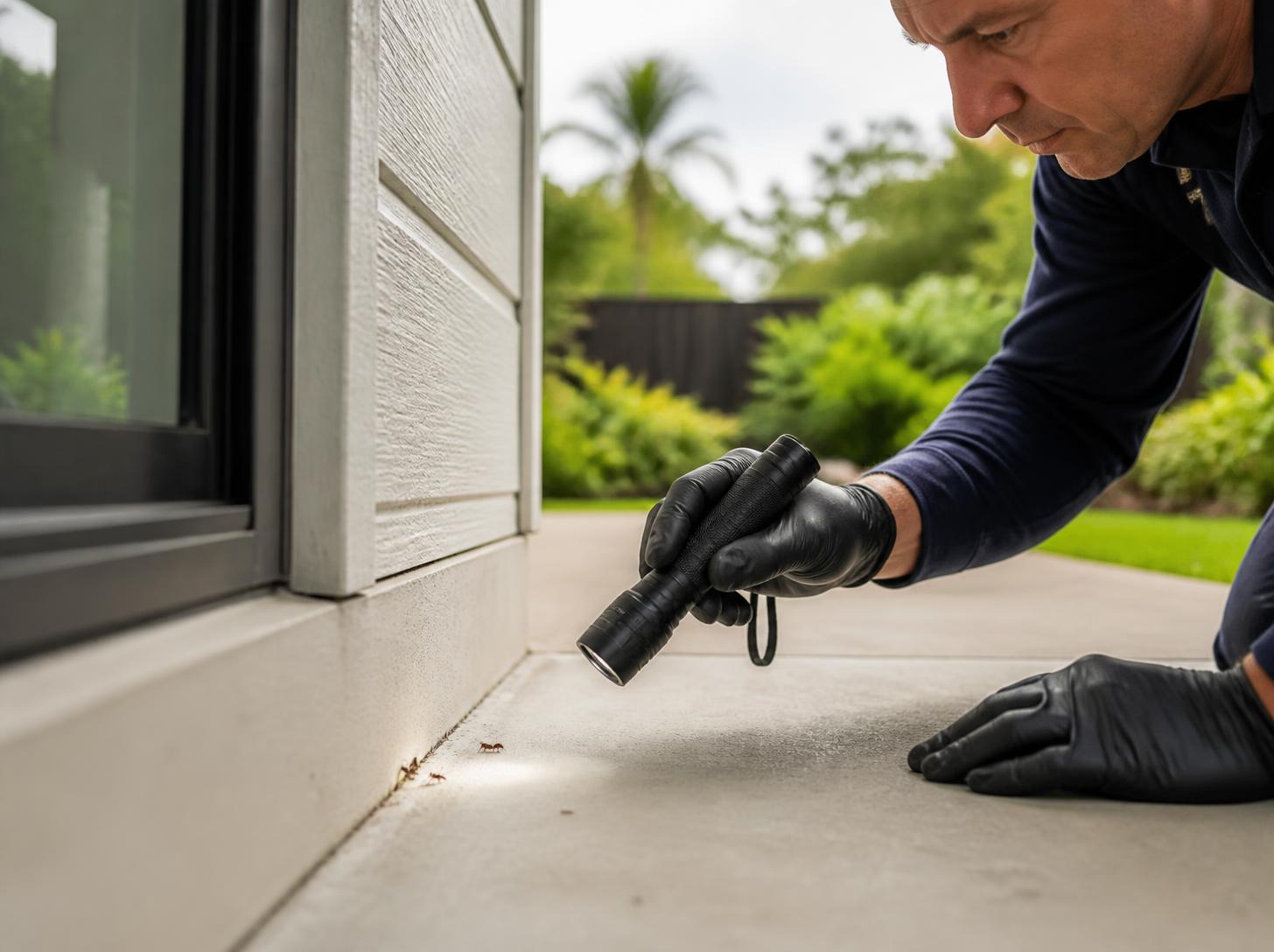
Torch across the top of the insulation, looking for droppings, disturbed batts, smear marks along joists and daylight at the eaves. Wear a P2 mask and gloves; step only on the joists.
Subfloor
Look for droppings on the ground, disturbed soil, runways and gaps at vents. Check whether the access hatch actually closes.
Kitchen and pantry
Pull out drawers fully and look at the backs and the runners; check behind and under the fridge, oven and dishwasher.
Garage and storage
Move stored boxes away from walls. Look at the backs of shelves and in stored soft goods.
Exterior perimeter
Walk the foundation line looking for burrows, runways, rub marks and any gap a pencil fits into — that is enough for a mouse.
What to do if you find evidence
Act reasonably promptly. Rodent populations grow quickly, and the difference between a problem caught in week two and one caught in month three is substantial in both cost and damage.
- Do not seal the building yet if there is active evidence inside — that traps them in. Treat first, then seal.
- Remove accessible food sources: pet food, compost, fallen fruit, open rubbish
- Photograph what you find. It genuinely helps us assess species and scale before attending.
- Book an inspection. A standard rodent treatment in Auckland runs $180 to $350 including GST, including a follow-up visit.
And if you are not sure whether what you have found is significant — send us a photo. We would rather tell you it is nothing than have you spend money finding that out.
Frequently asked questions
How can I tell rat droppings from mouse droppings?
Size is decisive. Rat droppings are 12–18 mm, dark, spindle-shaped with pointed ends. Mouse droppings are 3–6 mm, roughly the size and shape of a coarse grain of rice. If you are finding both sizes you may have both species, which is not unusual.
How many droppings means a serious infestation?
A rough guide: a single rat produces around 40 droppings a night and a mouse around 50 to 80. Finding a handful in one location suggests light or recent activity. Finding dozens spread across several areas suggests an established population that has been present for weeks.
Does seeing a rat in daylight mean the infestation is bad?
Usually yes. Rats are nocturnal and avoid people. Daytime sightings typically mean the population has grown large enough that competition is forcing individuals out during the day, or that the nest has been disturbed. It is not a signal to ignore.
What does a rodent infestation smell like?
A stale, musky ammonia odour, coming from accumulated urine. It is most noticeable in enclosed spaces — roof spaces, subfloors, cupboards — and tends to be strongest close to the nest. Once you have smelled it you will recognise it again.
Can I tell how long rodents have been there?
Roughly. Fresh droppings are dark, moist and soft; older ones are grey, dry and crumble when pressed. Well-developed smear marks along joists take weeks to form and indicate an established route. A nest with shredded material suggests breeding, not just passage.
What gets rid of rats quickly?
Snap traps on their runways, set against walls and joists where you have found droppings and smear marks, are the quickest method because they kill the night a rat steps on one. Rodenticide takes several days. Neither is quick in the sense that matters unless the entry points are sealed as well, because a new rat arrives through the same gap. Our guide to choosing rat traps and bait covers placement in detail.